
Interview
By Lilly. K. Drew
Written 22nd July 2022. Last edited 8th October 2026.
The Pagan historian and scholar on Wicca, fantasy novels and parallels with the 1960s.

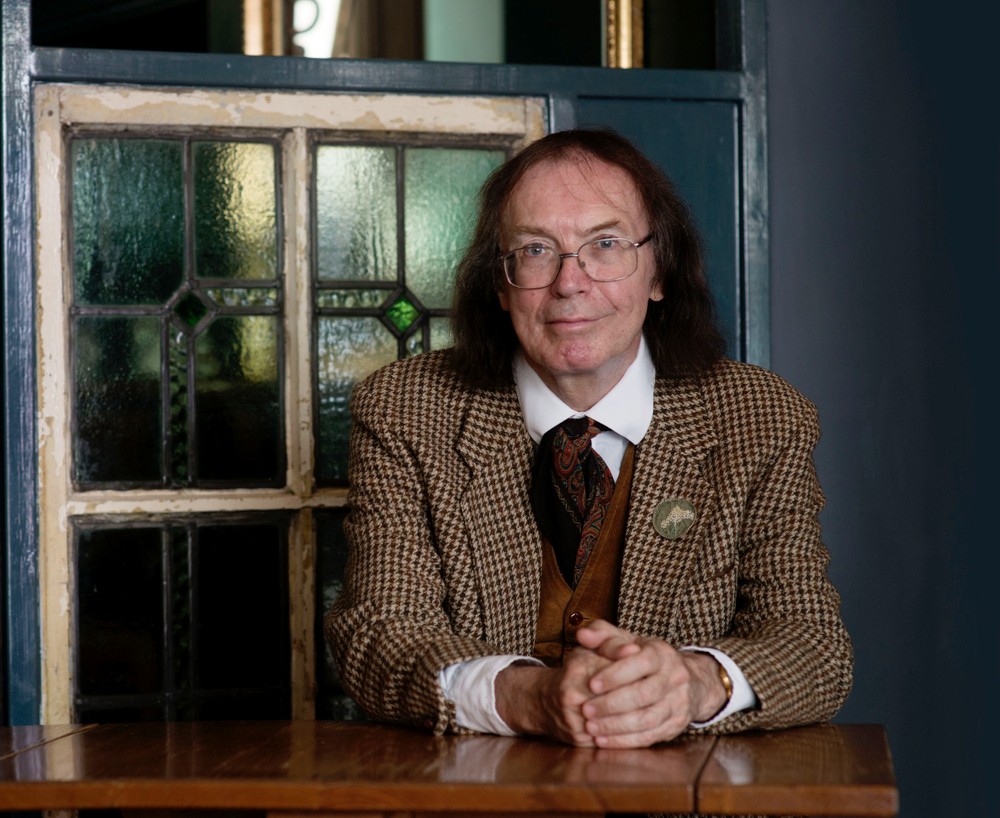
The UK’s leading historian of modern paganism, Professor Ronald Hutton lectures at Bristol University. Notable works include his 1999 book ‘Triumph of the Moon’ and his 2008 book ‘The Druids’.
In an interview with Gary Lachman in The Independent in May 2007 you were discussing your latest book ‘The Druids’. You raised the notion of ‘invented tradition’, saying that;
‘it relies upon an original foundation myth that has subsequently been disproved but has made itself worthy of respect in its own right’
Would you care to elaborate on this notion?
“Yes, with pleasure. Very often you find that modern spiritual traditions and newly appeared religions are based on an idea of the past gained from the academics and the leading scholars of the time in which the tradition appeared, which have now been rejected by more recent generations of scholars. And yet, the traditions themselves, that have been based on this original notion of the past, filtered through now obsolete scholarship are actually often very viable. They address very real needs, and as religions and spiritualities, they hold up remarkably well, in other words, they don’t need the original foundation story in order to prove themselves.”
I would like to ask you about Rationalism and Theism.
As a journalist, my responsibility is to seek the truth. But as a Pagan, I believe all humans have an innate desire for spiritual fulfilment. This could be considered irrational since most of my beliefs cannot be proven.
How do I reconcile these contradictions, and do you believe that there is evidence to suggest that the resurgence of interest in Paganism could be one result of this?
“I certainly think that the resurgence in interest in Paganism is one result of people feeling that rationalism simply doesn’t meet their sense of how the cosmos works, and I think that’s why religious and spiritual activity and belief will continue indefinitely. But I also think that a tendency toward being religious or being spiritually active is just a result of genetic accidents in the gene code. I am not suggesting that the experience with beliefs are not real, but I am suggesting that the aptitude for religion, in other words, an openness to it, is just born into some people and not into others like an aptitude for mathematics, or music, or languages, or empathy, so that some people just find it natural to have that extra dimension to the world and others don’t.”
In The Triumph of the Moon (page 63) you record how G K Chesterton argued that Christian Culture had absorbed all that was good about the Pagan world and added a superior ethic.
Today the reverse appears to be the case. Traditional religious dogma (especially Christian) does not seem to be a superior exemplar of the value systems of my generation. This seems to be particularly true for young women, like me. I find it hard to reconcile the teachings of the Church with my own values. However, I find it quite ironic that some of the most influential writers of my generation, C. S. Lewis, J. R. R. Tolkien and, especially, J. K. Rowling are self-declared Christians. These people laid the foundations for my journey into Paganism and enriched my life. Do you have an explanation for this apparent contradiction?
“Yes I have and I’m not the first person to seek one. I am thinking for example of the little-known, but lively autobiographical essay by the famous American pagan witch ‘Star Hawk’, which is entitled ‘How Narnia Made Me a Witch’. I think what above all, Tolkien and Lewis and their generation of fantasy writers did, was argue for the legitimacy of the importance, the value, of fantasy. Of imagined worlds, or worlds that seem to be imagined to others. What Tolkien called sub-creation; the creation of one’s own universes, and it was this argument for the power and value of the human imagination and the dispersal of the disapproval that has hung around the concept of fantasy, in most of the 20th century that there really is any contribution, and Chesterton in his own way made it too. So in a sense, their own belief systems actually are irrelevant. What they are arguing for is the value of the imagination and the fantasization for everybody, and since for a lot of Pagans, their journey into paganism is a journey into another world, or an enhanced dimension of this one, then the arguments of these Christians work for all spiritual traditions and religions.”
In your documentary ‘Britain’s Wicca Man’ you spoke of the 60s social revolution. You declared “As the ’60s began to swing, Wicca’s emphasis on gender equality, nature worship and sacred sexuality made a perfect fit for the historical moment. It is almost as though Gerald had predicted how the world was about to change.”
Wicca is still prevalent today. Can you draw any parallels between the social issues of the ’60s and the prominent socio-political and ecological issues of today, including the continued fight for equality, which has expanded to include the LGBTQ+ community? Do you feel that these modern issues reaffirm the importance of Wicca within our society?
“Yes, yes, that is an easy one to answer. I think the issues that first came into prominence in the 60s of adjustment to a new kind of late modern society, are the same issues that are still running today because we’re still forming that society and working through some of the birth pangs that are involved in producing it. Clearly, the issues of a multicultural or equal society are as pressing now as they were in the ’60s and in many ways the programme that was proposed in the ’60s has only really been implemented now with the sense of the need to integrate different sexual preferences, different ethnic groups, the true equality of the genders into a modern society. And since we addressed those issues right at the start, it has an obvious relevance at the present.
My understanding is that most traditional Wiccans worship the God and Goddess and that the Great Rite is an act of actual or symbolic ritual sexual intercourse between the two deities involving athame (male) descending into the chalice (female). This appears to suggest that traditional Wiccan practice, as followed by Gardnerian Wiccans, wasn’t particularly accepting of today’s sexual mores. This has led some Wicca practitioners to suggest that Gardner was homophobic (1)
For example, in his book Witchcraft Today (2), Gerald Gardner states that:
The witches tell me ‘The law always has been that power must be passed from man to woman or from woman to man, the only exception being when a mother initiates her daughter or a father his son because they are part of themselves’ (the reason is that great love is apt to occur between people who go through the rites together.) They go on to say: ‘The Templars broke this age-old rule and passed the power from man to man: this led to sin and in doing so it brought about their downfall.
However, this particular passage refers to the Templars and others suggest that the reference is not to Gardner’s own opinion of homosexuality but that of earlier Christians.
Do you have any reason to believe these accusations, or do you believe that Gardner was just reflecting the sexual mores of his time?
“I think that Gardner certainly made statements that suggest hostility to gay relationships. We cannot tell whether he has reflected his own deeply held beliefs, as they might have done, given the generation in which he grew up, or whether he was making public declarations or trying to reassure followers of his that Wicca had certain restraints and moral standards that approximated more to the general mores of the ’50s and early ’60s than what most of Wicca did. In other words, he was trying to make Wicca seem more acceptable, whichever of those possibilities were true. It’s very easy to adapt Gardnerian Wicca, Gardner positively invited it. He said that, to his people, that his book of shadows was not a set liturgy, not a scripture, but a private ad hoc book of spells and rituals assembled by an individual, and therefore, it’s perfectly in order for people to adapt Gardner’s liturgy or any Wiccan liturgy to their own taste and needs, and the relationships between the female and male can simply be adjusted by using the words ‘lover’ instead of ‘male’ and ‘beloved’ instead of ‘female’, to indicate a kind of electric current between, at the moment, active and receptive roles.”
Do you feel that this is why Wicca is such a popular religion, and a growing one for young people, because of its adaptability?
“I’m not sure, I haven’t carried out the research on young people to ask them directly why many of them are attracted to Wicca. I think that Wicca is in many ways an individual spirituality of self-empowerment, which is at least equal to the sexes, and possibly favours the feminine, and has a spiritualised view of nature. So you put that package together, it’s not difficult to see why a lot of contemporary young people might find it attractive.”
According to the Pew Research Centre survey of 2014 and the American Religious Identification Survey of 2012, the decline in Christian belief in the “West” and the Pagan revival both have occurred over a fifty-year period. They indicate profound spiritual shifts in this one part of the world – which I suspect is mirrored in the UK and Western Europe.
However, this trend is not followed in the former Leninist states of Europe where no significant change in Christian identification has occurred, indeed Armenia, Russia, Belarus and Ukraine have seen an increase in Christian identification.
Do you think that this is because they are, in modern terms, a bit behind the times, or could this be as a result of a re-emergence in nationalism, the recent migrant crisis, or even, a reaction to the perception that the West is becoming more aligned with Socialism?
“I think that it’s certainly linked to nationalism, but I think there’s a major factor that outweighs the others and it wasn’t on your list, which is that under the years of communist rule, Christianity was divided, disestablished and to some extent persecuted, and so it was a mode of resistance to the dominant culture and acquired a patina, the kind of heroic glow of a faith of resistance, liberation and martyrdom in the cause of personal choice. And therefore, to people in the recent, poor of the communist bloc, Christianity occupies a lot of the moral ground of paganism in the West, as being the spirituality and religion of personal liberation and choice. After it’s settled in and maybe if it becomes established again, then I think that particular mantle will cross to other movements including paganism. In areas of the Eastern bloc, where communist regimes were more imposed from outside and less ingrained in the population, like the Czech Republic, there’s a very lively new pagan movement, and that might be a symptom of what will happen more broadly in the former Warsaw Pact.”
In relation to the last question, in Scandinavia, Russia and Eastern Europe there are an increasing number of Norse Pagan groups who have taken on a right-wing nationalist viewpoint. Have you seen any evidence of this, and if so, is it specific to these regions, or mirrored by Norse groups in the UK or elsewhere in the West?
“It’s certainly mirrored by Norse groups in the UK and the west, most particularly America, where a whole division of the northern tradition there is allied to the white supremacist movement. But it must also be said, these are small numbers of people, especially in the UK, and they are neither representative of paganism as a whole, nor do they show any signs of taking over a larger share of it. They shouldn’t be dismissed because they’re worthy of study and interest in their own right, and they have their own importance of a subset of paganism, but as far as paganism is concerned as an umbrella movement in the west, they really are a not terribly important minority.”
Leave a Reply